 PlateyGet the app
Progressive Overload: What to Add Each Week, With a Log
Progressive overload means adding a little demand over time. The five variables you can push, a worked week-by-week example, and how double progression fits.
Progressive overload means gradually increasing the demand on your muscles so they keep adapting. The extra demand can come from more load, more reps, more sets, a larger range of motion, or less rest between sets.
What you can change
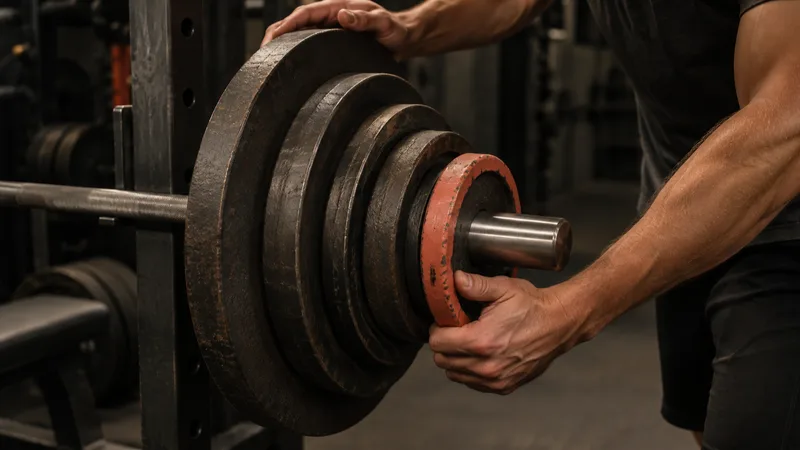
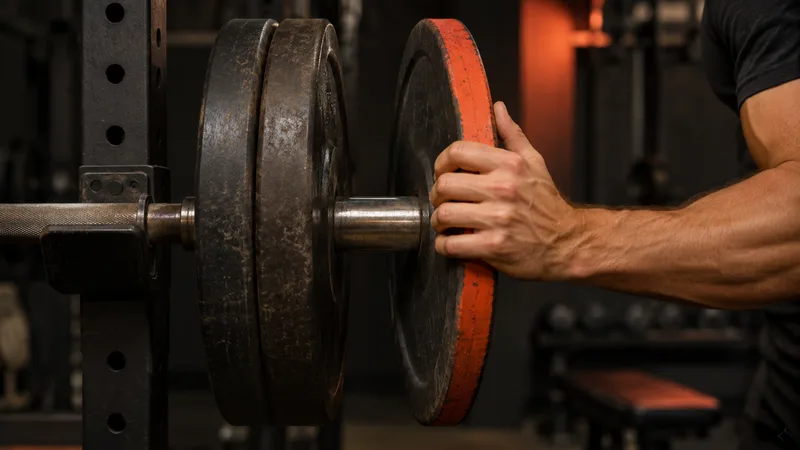
Only one variable has to move for a session to count as progress. Load is the easiest to log and the easiest to stall on, because your plates set the step size. The smallest jump you can make is twice your smallest plate: 2 × 2.5 lb = 5 lb (about 2.3 kg), or 2 × 1.25 kg = 2.5 kg.
| Variable | How you push it | Smallest step |
|---|---|---|
| Load | More weight on the bar | Twice your smallest plate (5 lb or 2.5 kg) |
| Reps | One more rep at the same load | 1 rep |
| Sets | One more working set | 1 set |
| Range of motion | Deeper squat, fuller stretch, longer pause | Small, hard to measure |
| Rest | Same work in less time | Whatever you can time |
Reps are the finer dial. One extra rep at 135 lb (135 × 0.45359237 = 61.2 kg) is a smaller step than 5 lb, which is why reps usually move first and load second. The two are linked: the more reps you can get from a weight, the smaller that weight is relative to your one-rep max.
You can push range of motion and rest too, but they are harder to compare across sessions. A deeper squat with the same bar is more work. Cutting rest from 3 minutes to 2.5 makes the same sets harder (common practice, not a measured rule), and it also caps the load you can handle, so treat it as a side effect of a busy gym rather than a plan.
Double progression, worked week by week
Double progression means reps go up first, then load. Pick a rep range, say 8 to 12 for 3 sets (common practice). Stay at the same weight until every set reaches 12, then add the smallest load you can and start again near the bottom.
Bench press, 135 lb, 3 sets of 8 to 12, smallest plates 2.5 lb:
| Week | Load | Reps per set | Total reps | Reps × load |
|---|---|---|---|---|
| 1 | 135 lb | 8, 8, 8 | 24 | 24 × 135 = 3,240 |
| 2 | 135 lb | 10, 9, 8 | 27 | 27 × 135 = 3,645 |
| 3 | 135 lb | 12, 11, 10 | 33 | 33 × 135 = 4,455 |
| 4 | 135 lb | 12, 12, 12 | 36 | 36 × 135 = 4,860 |
| 5 | 140 lb | 9, 8, 8 | 25 | 25 × 140 = 3,500 |
Week 4 is the trigger: all three sets at the top of the range. The next session goes to 135 + 5 = 140 lb, and reps fall back to 9, 8, 8. Reps × load drops from 4,860 to 3,500, which looks like a step backwards, but the bar got heavier and the rep climb starts again.
In kilograms the same pattern runs on 2.5 kg steps: 60 kg for 3 sets of 12, then 60 + 2.5 = 62.5 kg for 3 sets of 8.
Linear progression is the simpler cousin. Reps stay fixed and load rises every session: 3 sets of 5 at 135 lb, adding 5 lb each time, gives 135, 140, 145, 150, 155 over five sessions (135 + 4 × 5 = 155). That works while you can still recover between sessions. When it stops working, double progression buys you more room, because reps move in steps of one. The trade-offs between the two are covered in linear vs double progression.
Deciding the next session from your log
Progressive overload is a comparison, so you need the previous session in front of you. Four fields are enough: exercise, load, reps per set, and a note when something changed (deeper squat, shorter rest, a grinding last rep).
Before your first set, while you are still fresh, read last time and pick one target. If last week was 135 × 10, 9, 8, this week is 135 × 11, 9, 8. If last week was 12, 12, 12, this week is 140 × 8.
Platey suggests the next weight and reps from your last session, includes a plate calculator for loading the bar, keeps the log on your phone, and has no ads. A notebook does the same job if you read it before you lift.
When adding stops working
If the same load and reps repeat for a few sessions, look at something other than the number: sleep, food, or how many hard sets you are doing that week. Common practice is to repeat the weight once more, or take a lighter week and return to it.
Check that the progress is real, too. Cutting depth, bouncing the bar, or rushing rest to hit a rep target makes the log look better while the work stays the same or falls. Keep the movement standard fixed and let the numbers move slowly: a stall with honest form is information, and a personal best with a quarter squat is not.
Summary
- Progressive overload is more demand over time; load, reps, sets, range of motion and rest are the dials.
- Reps move in steps of 1. Load moves in steps of twice your smallest plate, so 5 lb or 2.5 kg with standard small plates.
- Double progression: fill the top of the rep range on every set, then add the smallest load and climb again.
- Log load and reps per set, and read them before your first set to pick one target.
- Hold form and rest steady, or the numbers stop being comparable.