 PlateyGet the app
RPE vs RIR: What the Numbers Mean and Which to Log
RPE 10 means zero reps left; RIR 2 means two. How the scales pair up, how to log effort per set, and why newer lifters tend to overestimate reps in reserve.
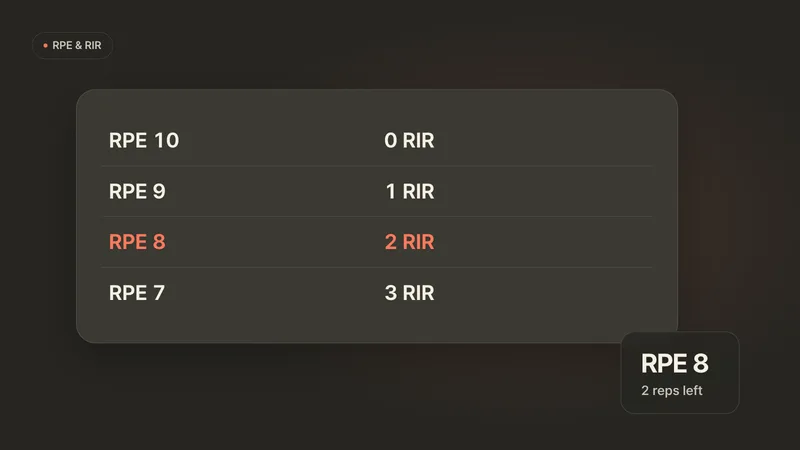
RPE and RIR both describe how hard a set felt. RIR (reps in reserve) is your estimate of how many more reps you could have done. RPE (rating of perceived exertion) scores the effort on a 10-point scale. In the resistance-training version of the scale, RPE 10 means zero reps left, RPE 9 means one left, and so on. Pick one and log it after each working set.
The same scale, written two ways
Zourdos and colleagues tested this scale in 2016. Starting at RPE 10 (0 RIR), each rep left lowers the effort rating by one point, so RPE 9 corresponds to 1 RIR.
| RPE | RIR (reps left) | Meaning |
|---|---|---|
| 10 | 0 | Could not do another rep |
| 9 | 1 | One rep left |
| 8 | 2 | Two reps left |
| 7 | 3 | Three reps left |
| 6 | 4 | Four reps left |
If you think in terms of "two reps left," log RIR. Use RPE if you prefer a 10-point effort score. The scale applies to hard working sets. A warm-up at RPE 4 falls outside that range.
How to log it after a set
When the set ends, estimate how many more reps you could have done with good form. That number is your RIR. Subtract it from 10 and you have RPE.
Say you bench 135 lb (about 61 kg) for 10 reps and think you could have done two more. Log RIR 2, or RPE 8. Next session you bench the same weight for 12 reps with one rep left. Your log shows you did more work and finished closer to your limit.
Helms and colleagues (2016) describe using RIR to adjust the weight from set to set. The estimate is more accurate with weights near your limit. After a poor night’s sleep, the same percentage of your 1RM may feel harder than usual. Your RIR estimate can reflect that change.
Newer lifters tend to overestimate reps in reserve
Zourdos and colleagues (2016) tested 29 squatters: 15 experienced (average training age 5.2 years) and 14 novices (0.4 years). Each did a 1RM squat plus single reps and an 8-rep set at set percentages of 1RM, rating RPE after each.
- Slower reps corresponded closely to higher RPE in both groups (experienced r = -0.88, novices r = -0.77). You can use bar speed to cross-check your effort rating.
- At their 1RM, experienced squatters gave higher effort ratings than novices (p = 0.023). The novices reached their true limit but scored it as less than maximal effort.
If you are new to lifting, "I had two left" is often optimistic. Early on, rate conservatively (assume fewer reps in reserve than you think) and treat a visible slowdown of the bar as evidence that the set was harder than it felt. Your estimates improve with practice. The researchers concluded that lifters can use the scale to adjust their daily training load.
A logged example
This lifter benched 135 lb (about 61 kg) for three working sets.
| Set | Weight x reps | RIR | RPE |
|---|---|---|---|
| Working 1 | 135 lb x 12 | 2 | 8 |
| Working 2 | 135 lb x 12 | 1 | 9 |
| Working 3 | 135 lb x 10 | 0 | 10 |
The lifter had no reps left on the third set. At RIR 2, the same 12, 12, 10 would leave room for two more reps on the last set. Weeks later, the effort rating tells you which day it was when the weights and reps look identical.
Platey suggests keeping the same weight if you logged any set at RPE 9.5 or higher last session, even if you reached the top of the rep range on every set.
When you can skip it
You do not need RPE on every set from day one. Weight, reps and set type are enough to run a progression rule, as described in What to Write in a Workout Log. Add an effort column when you want to separate "hit the target" from "hit the target at my limit". If the extra column makes you skip logging altogether, drop it until the habit is solid.
Summary
- RPE and RIR are one scale: RPE 10 = RIR 0, RPE 9 = RIR 1, RPE 8 = RIR 2.
- After each working set, estimate how many reps you had left and record the number in your preferred scale.
- Newer lifters tend to rate a true limit as easier than it is, so rate conservatively and watch bar speed.
- When you see "12, 12, 10" in your log, check the effort ratings before choosing your next weight.
Sources
- Zourdos MC et al. Novel resistance training-specific rating of perceived exertion scale measuring repetitions in reserve. J Strength Cond Res (2016), abstract via NCBI E-utilities, PMID 26049792
- Helms ER, Cronin J, Storey A, Zourdos MC. Application of the repetitions in reserve-based rating of perceived exertion scale for resistance training. Strength Cond J (2016), abstract via NCBI E-utilities, PMID 27531969