 PlateyGet the app
Fitbod vs Your Own Plan: Auto Workouts or Manual Logging
Fitbod vs your own plan: how the AI builds each session, when manual logging fits better, and Fitbod's limits, checked on Nov 28, 2026.
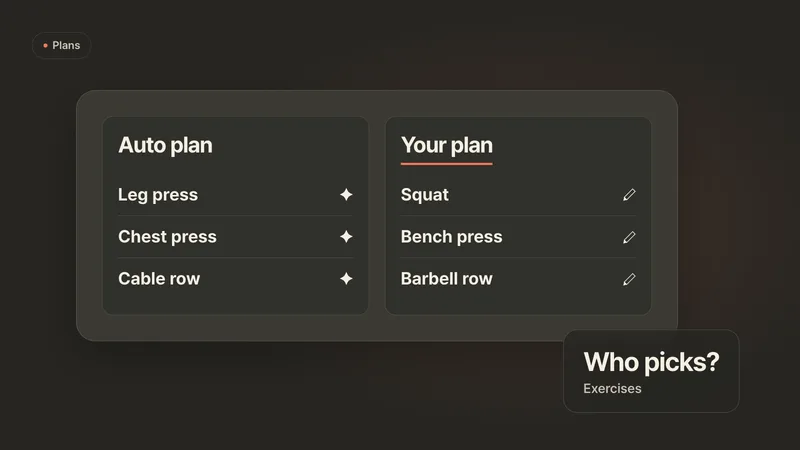
Fitbod picks every workout for you. You enter your goal, experience level and equipment, and its AI generates the session. With your own plan, you choose the exercises, and the app records what you did. Fitbod suits you if you dread deciding what to train. If you follow a fixed program or want to compare your logs from week to week, a manual log fits better. This is based on Fitbod's US App Store listing, checked Nov 28, 2026.
How Fitbod builds a workout
Per the listing, Fitbod uses non-linear periodization, so sessions vary instead of repeating the same Monday workout. It factors recovery and exercise tracking into its recommendations, and its adaptive AI learns from edits you make to a suggested session. You can choose favorite exercises and save your own routines, but Fitbod generates your workouts by default. The library has 1,000+ exercises with hi-res, multi-angle videos, searchable by muscle group, equipment or keyword.
What logging your own plan looks like
With a manual log, you pick a split, choose exercises for each day, and set rep ranges. Then you hold that structure for weeks and add weight or reps as you adapt. Keeping the exercises the same lets you compare this week's bench directly with last month's. You also know why each exercise is in the plan, which makes it easier to adjust when something is not working. This is common programming practice, not a claim about any one app.
When an auto plan fits
- You are new and do not know which exercises to pick.
- Deciding today's workout costs you more time than the workout itself.
- You get bored repeating the same session and want variety.
Fitbod gives you a workout to follow, varies the sessions and has videos for the exercises.
When your own plan fits
- You follow a set program. Strong's listing says it is optimized for progressive barbell routines such as Starting Strength or StrongLifts 5x5. Those programs assume fixed exercises; a generator that swaps exercises works against them.
- You train around a known weak point and want to choose your own accessory work.
- You judge progress by comparing the same lift across weeks. Frequent exercise rotation makes that comparison harder.
If you track the same lift across weeks, logging apps like Strong or Hevy keep the structure and leave the choices to you.
Integrations and steering the plan
Fitbod integrates with Apple Health, Strava and Fitbit, and runs on Apple Watch. The listing also says you can email pro fitness trainers with strength-training questions, and use workout modifiers to change up a single session. When you want more control over a generated plan, you can swap exercises, save favorites and build your own routines. The generated sessions scale across beginner, intermediate and advanced levels.
Fitbod's limits
Fitbod is iOS and Apple Watch only; there is no Android app. After the free trial, you need a monthly or yearly subscription. The exact price is not in the listing, and fitbod.me returned a bot challenge on Nov 28, 2026, so the amount is not verified here. Check the App Store before subscribing.
A middle path
You can keep your own routine and still offload the math. A log that applies a progression rule, like double progression, suggests the next weight from your last session while you keep control of the exercises. That is the approach I build into Platey: you pick the plan, and the app suggests your next weight and reps with a one-line reason.