 PlateyGet the app
Fractional Plates: Why 5 lb (2.5 kg) Jumps Stall Upper-Body Lifts
Fractional plates are 0.25-2.5 lb (0.25-1.25 kg) plates. Why 5 lb (2.5 kg) jumps stall bench and press, the percent math, and which small plates to buy.
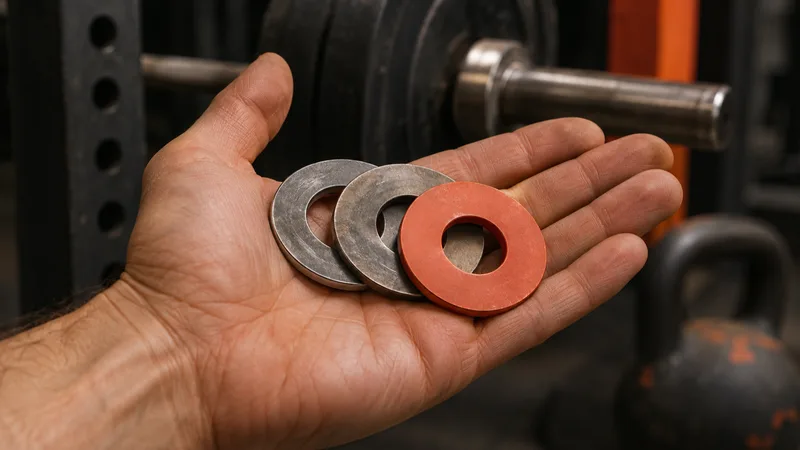
Fractional plates are small plates, usually 0.25 to 2.5 lb (0.25 to 1.25 kg), that let you load a bar in steps smaller than the usual 5 lb (2.5 kg). A pair of 0.5 lb plates adds 1 lb to the bar, which is often the difference between an increase you can lift next session and one you cannot.
Your smallest plate sets your step size
Plates go on both sides, so the smallest change you can make is twice your smallest plate.
- Smallest plate 2.5 lb: step = 2 × 2.5 = 5 lb.
- Smallest plate 1.25 kg: step = 2 × 1.25 = 2.5 kg.
- Smallest plate 0.5 lb: step = 1 lb.
- Smallest plate 0.25 kg: step = 0.5 kg.
Most gym plate sets stop at 2.5 lb or 1.25 kg by convention. That leaves you with 5 lb (2.5 kg) as your only option for adding load, on every lift, at every stage.
Progressive overload means increasing the demand on the muscle over time, and load is one of the levers you can pull. It works best when the increments are small enough to keep the lift moving.
The same jump, different percentages
A 5 lb step is always 5 lb, but the percentage depends on what is already on the bar. Divide the increase by the current bar weight to see what you are actually asking for.
| Lift | Load | +5 lb | +1 lb (pair of 0.5 lb) |
|---|---|---|---|
| Overhead press | 95 lb | 5 ÷ 95 = 5.3% | 1 ÷ 95 = 1.05% |
| Bench press | 135 lb | 5 ÷ 135 = 3.7% | 1 ÷ 135 = 0.74% |
| Bench press | 185 lb | 5 ÷ 185 = 2.7% | 1 ÷ 185 = 0.54% |
| Squat | 315 lb | 5 ÷ 315 = 1.6% | 1 ÷ 315 = 0.32% |
| Deadlift | 405 lb | 5 ÷ 405 = 1.2% | 1 ÷ 405 = 0.25% |
In kilograms, with 1.25 kg and 0.5 kg plates:
| Lift | Load | +2.5 kg | +1 kg (pair of 0.5 kg) |
|---|---|---|---|
| Overhead press | 40 kg | 2.5 ÷ 40 = 6.3% | 1 ÷ 40 = 2.5% |
| Bench press | 60 kg | 2.5 ÷ 60 = 4.2% | 1 ÷ 60 = 1.7% |
| Squat | 140 kg | 2.5 ÷ 140 = 1.8% | 1 ÷ 140 = 0.71% |
The 5 lb that gives your squat a 1.6% increase gives your press a 5.3% increase, more than three times as much. To match the squat's 1.6% on a 95 lb press you would need 95 × 0.016 = 1.5 lb. You cannot load 1.5 lb with a set that starts at 2.5 lb.
Bench and overhead press tend to stall first while the squat keeps climbing on the same plate set, because 5 lb is too coarse a step for those loads.
Worked example: 135 lb to 140 lb in five sessions
Say you bench 135 lb for 3 sets of 5 and want to reach 140 lb. With only 2.5 lb plates, the next available load is 140 lb, a 3.7% increase in one session.
With a pair of 0.5 lb plates you can go 135, 136, 137, 138, 139, 140. Each step is 1 ÷ 135 = 0.74% at the start and 1 ÷ 139 = 0.72% at the end.
Loading 136 lb on a 45 lb bar: (136 − 45) ÷ 2 = 45.5 lb per side, which is a 45 plus a 0.5. For 137 lb: (137 − 45) ÷ 2 = 46 lb per side, a 45 plus a 1. For 138 lb: 46.5 per side, a 45 plus a 1 plus a 0.5.
Same idea in kilograms. From 60 kg to 61 kg on a 20 kg bar: (61 − 20) ÷ 2 = 20.5 kg per side, a 20 plus a 0.5. That is a 1.7% step instead of 4.2%.
Five small sessions beat one failed attempt, and your log shows a line that keeps climbing. If you would rather add reps before load, that works with the same plate set.
What to buy
- Buy pairs. One plate on one side does nothing useful on a barbell.
- For sizes, an lb set of 0.25, 0.5, 0.75, 1 and 1.25 lb pairs gives you steps of 0.5, 1, 1.5, 2 and 2.5 lb. A kg set of 0.25, 0.5, 0.75, 1 and 1.25 kg pairs gives 0.5 to 2.5 kg. You rarely need all of them; a pair of 0.5 lb (or 0.5 kg) and a pair of 1 lb (or 1 kg) covers most cases.
- Check the hole. The centre hole has to fit your bar's sleeves. Olympic bars use the larger sleeve standard, so buy plates drilled for that size.
- Keep them in your bag. Small plates are usually your own equipment, not the gym's.
- Do not mix units. A pair of 1.25 kg plates adds 2.5 kg, which is 2.5 ÷ 0.45359237 = 5.51 lb, not 5 lb. Convert to one unit and log in that unit.
Small plates help on squats too, once 5 lb starts costing you reps.
How a plate calculator handles them
A plate calculator only knows the plates you give it. Add your fractional plates to the list and the arithmetic changes on its own: the reachable totals get denser, and the smallest step becomes twice the smallest plate.
Platey's plate calculator works from your own bar and plate list, picks the combination with the fewest plates, and drops to the nearest total that does not exceed the target when the exact number cannot be made. Without 0.5 lb plates in the list, a request for 136 lb comes back as 135 lb. With them, it comes back as 45 + 0.5 per side. The basics of that calculation are in Plate Math.
Platey also suggests the next weight and reps from your last session, so a small step is easy to repeat. The log stays on the phone and there are no ads.
Summary
- Your smallest possible increase is twice your smallest plate.
- 5 lb on a 95 lb press is 5.3%; the same 5 lb on a 315 lb squat is 1.6%.
- Fractional plates of 0.5 lb (0.5 kg) turn those jumps into roughly 1% steps.
- Buy pairs, check the hole size, and keep your log in one unit.
- A plate calculator only finds small jumps if the small plates are in its list.