 PlateyGet the app
Plate Math: How to Work Out What to Load on Each Side of the Bar
Subtract the bar, divide by two, and you have the weight per side. Standard lb and kg plate sets, worked examples, and the kg/lb mixing pitfalls.
Say you want 225 lb or 100 kg on the bar. The bar is already on the rack, with a stack of plates beside it. Which ones go on? You can work it out in your head before you reach for your phone.
The one-line formula
You load both sides the same, so per side = (target − bar) ÷ 2.
For 225 lb on a 45 lb bar: (225 − 45) ÷ 2 = 90 lb per side, which is two 45s. For 100 kg on a 20 kg bar: (100 − 20) ÷ 2 = 40 kg per side, for example a 25 and a 15.
The standard setup
Platey assumes this by default (you can change the bar and your plates in settings):
| Unit | Bar | Plates |
|---|---|---|
| lb | 45 lb | 45 · 35 · 25 · 10 · 5 · 2.5 |
| kg | 20 kg | 25 · 20 · 15 · 10 · 5 · 2.5 · 1.25 |
Gyms differ: some have a lighter bar, some have no 35s or no 1.25 kg plates. Check the actual bar weight and what you have before you calculate.
Worked examples
Each combination goes on one side. The examples use a 45 lb bar for pounds and a 20 kg bar for kilograms.
| Target | Per side | Check |
|---|---|---|
| 95 lb | 25 | (95 − 45) ÷ 2 = 25 |
| 135 lb | 45 | 45 |
| 155 lb | 45 + 10 | 55 |
| 185 lb | 45 + 25 | 70 |
| 225 lb | 45 + 45 | 90 |
| 275 lb | 45 + 45 + 25 | 115 |
| 315 lb | 45 + 45 + 45 | 135 |
| 100 kg | 25 + 15 | 40 |
| 140 kg | 25 + 25 + 10 | 60 |
Platey's calculator gives these combinations for the target weights shown. When several combinations make the same weight, it shows the one with the fewest plates. A load of 60 kg per side can be 20 + 20 + 20 or 25 + 25 + 10. Both use three plates, so Platey picks the combination that starts with the larger plates.
What if your number can't be made?
With a fixed set of plates, only certain totals are possible. If your smallest plate is 2.5 lb, each side goes up in 2.5 lb steps, so the total moves in 5 lb steps.
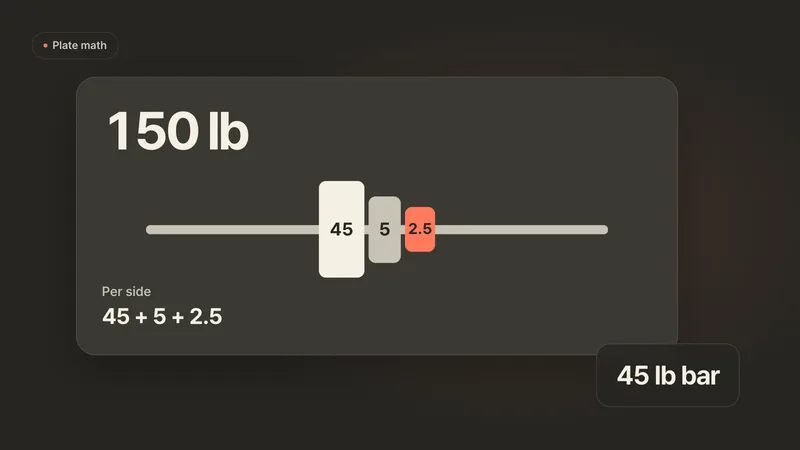
Ask for 152.5 lb and the answer is 150 lb. The target needs 53.75 lb per side, which you can't make, so you go to the closest total that doesn't exceed it: 45 + 5 + 2.5 per side, 150 lb in all. In kg it works the same way. With 1.25 kg plates the total moves in 2.5 kg steps, so 68 kg becomes 67.5 kg (20 + 2.5 + 1.25 per side).
This also sets your smallest possible jump between sessions. If your smallest plate is a 5, the smallest increase you get by adding plates is 10 lb (a pair of 5s). For help choosing the size of the increase, see Double Progression Method: How to Pick Your Next Weight.
When kg and lb get mixed
One pound is defined as exactly 0.45359237 kg (the 1959 International Yard and Pound Agreement). That is why the numbers never line up neatly:
- A 45 lb plate is about 20.41 kg, which is 0.41 kg more than a 20 kg plate.
- A 2.5 lb plate is about 1.13 kg, close to but not equal to a 1.25 kg plate.
- A 20 kg bar with a 45 lb plate on each side is 20 + 2 × 20.41 = about 60.8 kg, not 60.
If a gym mixes kg and lb plates, convert to one unit before adding, and log in one unit too. Otherwise two sessions that look like the same load can differ by a kilogram or more, and your history stops being comparable.
One thing the math can't do
You still need to check the bar, plates and collars yourself and make sure both sides are balanced.
Summary
- Per side = (target − bar) ÷ 2, made from your plates with as few as possible.
- If the target can't be made, drop to the closest total that doesn't go over.
- Twice your smallest plate is the smallest jump you get by adding a pair of plates.
- When kg and lb mix, convert before you add, and keep your log in one unit.