 PlateyGet the app
How Accurate Is a 1RM Calculator? Epley vs. Brzycki Math
Why do the Epley and Brzycki 1RM formulas agree at exactly 10 reps? A short algebra proof, a 3–12 rep table, and what the accuracy limits really are.
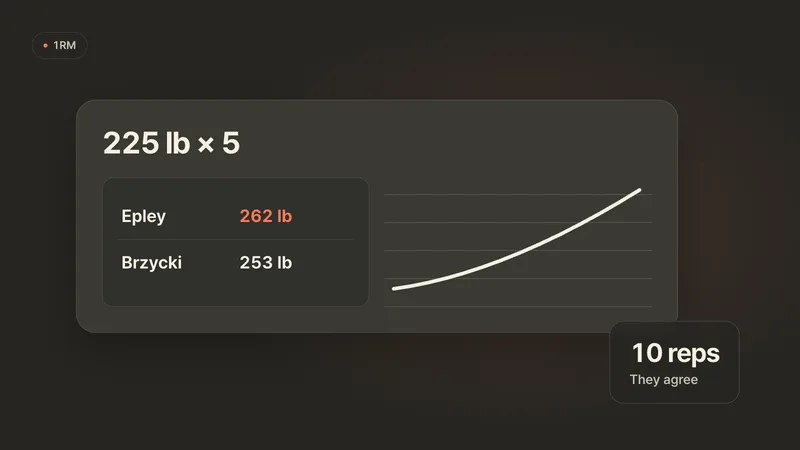
You squatted 225 lb for 5. What is your one-rep max? You can test your max or estimate it. Almost every online calculator gives you an estimate, usually with the Epley or Brzycki formula. The formulas agree at exactly one rep count. At other rep counts, the gap between them helps you judge how much to trust the estimate.
The two formulas
With weight w and reps r (for a single, the estimate is just w):
- Epley: 1RM = w × (1 + r / 30)
- Brzycki: 1RM = w × 36 / (37 − r)
According to Wikipedia, the Epley formula goes back to a poundage chart in Boyd Epley Workout (1985).
Same set, two answers
Take one set of 80 kg and apply both formulas (kg, one decimal):
| Reps | Epley | Brzycki |
|---|---|---|
| 3 | 88.0 | 84.7 |
| 5 | 93.3 | 90.0 |
| 8 | 101.3 | 99.3 |
| 10 | 106.7 | 106.7 |
| 12 | 112.0 | 115.2 |
Epley is higher up to 9 reps, they meet at 10, and Brzycki pulls ahead from 11. Wikipedia describes the same pattern: identical at 10 reps, Epley higher below that, and the formulas diverging a lot well beyond 10. Do the arithmetic for 20 reps and you get a 2.12 multiplier from Brzycki and 1.67 from Epley.
Why exactly 10?
Set the two multipliers equal and solve for reps:
1 + r/30 = 36 / (37 − r)
(30 + r)(37 − r) = 1080          multiply both sides by 30(37 − r)
1110 + 7r − r² = 1080            expand
r² − 7r − 30 = 0
(r − 10)(r + 3) = 0
Reps can't be negative, so r = 10 is the only solution. Below 10, (30 + r)(37 − r) is larger than 1080, which makes Epley the higher estimate; above 10, Brzycki is higher.
Multiply the weight you lifted by the factor for your rep count.
| Reps | Epley multiplier | Brzycki multiplier | Epley is higher by |
|---|---|---|---|
| 3 | 1.100 | 1.059 | +3.9% |
| 5 | 1.167 | 1.125 | +3.7% |
| 8 | 1.267 | 1.241 | +2.0% |
| 10 | 1.333 | 1.333 | 0% |
| 12 | 1.400 | 1.440 | −2.8% |
At most the two formulas differ by about 4% in this range. Which formula you pick matters less than how much you can trust the set you feed in.
How accurate is it?
Wikipedia lists several limits on accuracy.
- Estimates from lighter sets are often reasonable, but can miss your true 1RM by 10% or more.
- Using a formula built for the specific lift improves accuracy, which a one-size-fits-all calculator can't do.
- Most formulas were built for experienced lifters. A novice's actual max can be much lower than the estimate.
- The two formulas diverge a lot well past 10 reps, so high-rep sets give shakier estimates.
Treat an estimated 1RM as a reference number: a starting point for planning your next sessions, not a weight you should go and test. Whether to attempt any weight is your call, based on your own preparation.
How Platey calculates it
Platey chooses a 1RM formula based on how many reps you logged.
- 1 rep: the weight you lifted
- 2 to 8 reps: Brzycki
- 9 to 12 reps: Epley
- 13+ reps: no estimate
At 9 reps the two formulas differ by only about 1.1% (104.0 vs. 102.9 for 80 kg), so the exact switch point isn't dramatic. Platey uses that cutoff by design, without claiming research support for it. The app skips sets of 13 reps or more because the formulas drift apart and the estimate gets unreliable.
The app calculated the estimates in the table. You can check any cell by hand, for example: 80 × (1 + 5/30) = 93.3 and 80 × 36 / 32 = 90.0.
Summary
- Epley is w × (1 + r/30); Brzycki is w × 36 / (37 − r).
- After a single, the two agree at exactly 10 reps: Epley is higher below, Brzycki above.
- They differ by about 4% at most here, but either can be 10% or more off your real max, so use the number as a reference.
- To see what you do with an estimate, read Double Progression Method: How to Pick Your Next Weight.