 PlateyGet the app
What to Write in a Workout Log: Five Things to Record for Every Set
A workout log isn't better for being longer. Five per-set fields that decide your next weight, how to note effort with RIR or RPE, and a worked example.
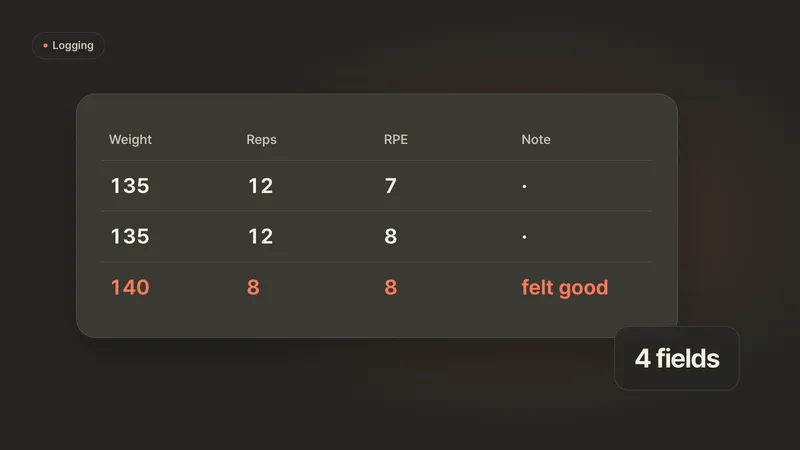
Record each set so you can look back at what you did when you train again. Five fields are worth keeping for that purpose.
Why bother
To pick your next weight you need to know what you lifted last time, set by set. The rule in Double Progression Method: How to Pick Your Next Weight only works if the log has the weight and reps of every working set.
Five fields, every set
1. The weight you actually lifted
If the plan called for 60 kg and you dropped to 57.5 kg for the last set, write down 57.5. Recording the planned weight would give you the wrong starting point for your next session.
2. The reps you actually did, per set
A single entry like "3 × 12" can hide differences between sets. Log the reps for each one. 12/12/12 and 12/12/9 lead to different next sessions: under the rules in the double-progression post, 60 kg for 12/12/12 goes up to 62.5 kg, while 12/12/11 stays at 60 kg.
3. The set type
Mark warm-up, working and drop sets. If you add up volume (weight × reps), you need to decide whether warm-ups count, and a progression rule should only look at your working sets.
4. How hard it was: RIR or RPE
RIR is reps in reserve: how many more reps you could have done when the set ended. RPE is an effort rating from 1 to 10, and on the RIR-based version RPE 10 means 0 reps left, RPE 9 means 1 rep left, and so on.
Zourdos and colleagues (2016) had 29 people, 15 experienced squatters (about 5.2 years of training) and 14 novices (about 0.4 years), rate their sets on this scale. They found a strong inverse relationship between bar speed and RPE (r = −0.88 in the experienced group, −0.77 in the novices) and concluded that the RIR-based scale is a practical way to regulate daily training load. Helms and colleagues (2016) wrote a companion piece on applying it in a training plan.
You don't need precision at first. Asking "could I have done more?" after each set and writing a number is enough to start.
5. A one-line note
If you switched machines, changed your grip or took a shorter rest, you may need that detail to repeat the set under the same conditions. Keep the note to one line about what changes the next session.
An example
One bench press day (date and exercise omitted):
| Set | Type | Weight (kg) | Reps | RIR | Note |
|---|---|---|---|---|---|
| 1 | Warm-up | 40 | 8 | — | |
| 2 | Working | 60 | 12 | 2 | |
| 3 | Working | 60 | 12 | 1 | |
| 4 | Working | 60 | 10 | 0 | Last set slowed down a lot |
The working sets are 12, 12, 10. That matches the second rule (every set at least 8, but not all at 12), so the next session is 60 kg, aiming for 12. The rule skips the warm-up set. You'd get the same answer without the RIR column, but only the RIR tells you the last set was really your limit.
Start with three
If five fields feel like too much, start with weight, reps and set type. A progression rule can run on those alone. If logging takes too long, you stop doing it, so cut columns before you add them.
Summary
- Log the actual weight and reps, per set.
- Mark the set type: warm-up, working, drop.
- Note effort with RIR or RPE, even by feel.
- Keep the note to one line about what would change next time.
Sources
- Zourdos MC et al. Novel resistance training-specific rating of perceived exertion scale measuring repetitions in reserve. J Strength Cond Res (2016)
- Helms ER, Cronin J, Storey A, Zourdos MC. Application of the repetitions in reserve-based rating of perceived exertion scale for resistance training. Strength Cond J (2016)